Monday, November 28, 2011

Forensic Science Project: Lipstick Experiment Analysis

Lipstick Analysis-Reflection

In this particular experiment we identified the different types of lipstick prints and used chromatography to see if the print was non polar or polar. First what our class did was take a particular lip gloss sample and put it on our fingertip. We took the lip gloss sample that was on our fingertip and rubbed it all over our lips. Next we took a a small note card and smudged our lip gloss print on the note card. Then immediately we identified the different aspects of our lips. For example, my lips were plump and juicy. I also notified that there were patterns of vertical streaks in the skin of my lips. There was a gently dip upon the top of my lip. Between my lips there was  a shorter distance of space.This experiment helped me  understand the different types of lips that everybody has such as small, big,and thin. Also the experiment taught us the meaning  of chromatography to see if the print was polar or non polar. I did not know there were some many things you can test just for a lipstick print. I never really paid that much attention to my lips. This experiment was very fun in seeing everybody have a different lip print. I did not know a lipstick lab could be this exciting in forensic scientist. The experiment can be used my forensic scientist students to identify the incomparable features of different lips.

My group also did a test with the chromatography solution which consisted of water.First we dotted lip gloss on a piece of chromatography paper. The second step  we did was  hung the chromatography piece of paper on the side of the beaker. My group waited five minutes to see if it bleed through the paper. As we saw the results our group,we concluded that the lipstick print was non polar.                           

Sunday, November 27, 2011

Forensic Science Project Part III: Handwriting Analysis

  Research a famous forgery case and explain how forensic handwriting analysis was used to expose the forgery.


http://history1900s.about.com/od/people/p/hughes.htm


Clifford Irvington Case

Forgery is the process of making counterfeit notes and forgery can have serious consequences to go with it such as a prison term of between two to ten yrs. In this particular forgery case, Clifford Irving who is an American author forged letters of Howard Hughes to get a publishing contract for his life story. Howard Hughes during that time was not in the outside world no one had saw Howard Hughes for more than a decade. Many people thought Howard Hughes was dead. Some authors wrote about Howard Hughes life. Clifford Irving and author friend Richard “Dick” Suskind met again while going on a trip to Ibiza. They struck a conversation about Howard Hughes. Then while they both talked they thought of a crazy idea. The idea was that he would persuade the publisher McGraw-Hill that the legendary Howard Hughes told him to write autobiography about himself. The book is based on interviews with Howard Hughes. Then Howard Hughes had to take up for himself once the book was published. Clifford Irving did an interview with Mike Wallace and he said that Howard Hughes was sick and was unable to defend himself against the book. So after the interview Clifford Irving wanted to make the book look valid so he forged letters and legal documents that looked like Howard Hughes writing. Later on Howard Hughes heard about the book from his manager or associates. He made a lawsuit against the publishers company pertaining to Clifford Irving. Clifford Irving was revealed of doing this crime by handwriting analysis made by the U.S Postal Service. The handwriting analysis identified that the letters Clifford Irving forged had a certain style that lay in a form of certain letters having strokes. During the trial, Clifford Irving confessed to his forgery and was convicted of fraud. He spent 17 months in a Pennsylvania prison.

This case specifically shoes how handwriting characteristics can make a fool out of people that think they can get away with crime. Clifford Irving was so stupid thinking he could get away. If he wanted money that bad he could of just wrote his own book not about a famous person just to make a quick buck. It is important that people know that if you do a crime you going to do the time. It was just easier writing his own book try to promote it. Then get a lot of money for it instead of sitting in jail. Handwriting analysis would probably convict him too but I guess handwriting so perfect to Howard Hughes handwriting. The handwriting analysts saw particular strokes in his handwriting maybe they resembled the same as his but the good thing is he confessed it before the case turned ugly.


Irving, Clifford. "Clifford Irving's Hoax." Tru Tv Not Reality.Actuality. Web. 2 Dec. 2011. <http://www.trutv.com/library/crime/criminal mind/forensics//literary/2.html>.

This website gets the credibility of the idea of the research about the forgery case including Clifford Irving.


Citation for pictures


This website gets the credibility for the visual image of Clifford hoax and Howard Hughes

 links

Saturday, November 26, 2011

Forensics Sciene Project Part III: Handwriting Analysis

Reflection on the Check Forgery Activity (Explain the steps/process of your check forgery?  Did you and your group identify the proper person/persons who did the forgeries?  Which characteristics were the most distinguishing in your analysis?)


Check forgery Activity


In this check forgery activity, I learned how to observe forgery by using handwriting analysis characteristics .In our group each person wrote a counterfeit check to someone or an organization and then ripped up the check. Any way after each person ripped their check we gave the pieces to the other table to figure out who wrote these particular check forgeries. Then our group took four additional checks from another table and reconstructed them. We reconstructed there check and compared there writing to the handwriting analysis template. As I observed the letters of the words on the check, I automatically linked them to the handwriting analysis template. I did find out who was the person who forged the checks. I took notes on the different handwriting characteristics on the checks. The characteristics that were distinguishing on the check had backward strokes, pen lifting occurring, curls on the end of the letters, backward letters, and pen lifting was occurring  throughout  the letters of the words. With the information analyzed, I automatically knew who forged these checks.


This activity was fun in analyzing handwriting characteristics in check forgery. Check forgery was not that important to me in some cases. Now I automatically know how to analyze who wrote a forged check and who did not. Check forgery is also a serious problem. Anyone can go to prison for check fraud. So it is best not do it so you will not get into trouble. Just write your own checks then you will feel confident in yourself then getting prison time and being embarrassed.


Anaylsis:

The letters do not flow, her letters are very consistent. Capital letters do not conncet with lower case, and my letters are done in a downward motion. There is also a lot of pressure. There is no slant or fancy habits.

Friday, November 25, 2011

Forensics Science Project Part III: Handwriting Analysis

Pictures and Analysis of Handwriting Analysis Template.  State how the free handing forgery and tracing forgery differ using the 12 Handwriting Characteristics.  In other words, how would you tell that they are forgeries? 

In the Handwriting template activity we learned how to do free hand forgery and trace hand forgery by copying someone else handwriting characteristics. The first step was free hand forgery. I copied my own handwriting on the original sample of the handwriting template. I copied my handwriting in cursive and print. I wrote a sentence that said the quick brown fox jumped over the lazy dog. After I copied my handwriting, I gave my handwriting template to another classmate. She analyzed my handwriting. My analysis section of my original sample said that there was pen lifting occurring and there were different ratios of height, width and size of letters. I usually start of doing cursive letters then I end with print letters. It is a weird way of writing but I will change my habit. Next, my classmates’ free hand forged my handwriting in the other part of the handwriting template. When the classmate was done, their handwriting did not match my handwriting whatsoever. Actually, the person who was trying to forge my handwriting said it was too hard to copy and almost gave up. Then we used trace hand forgery. The trace hand forgery was easy because all you had to do was trace their handwriting. The handwriting that my classmate’s did was very similar to mine because she used traced hand forgery handwriting. Her handwriting had the similar downward stokes and huge letters in it like I did.
I think free hand forgery is harder than trace hand forgery because you would have to try glancing at the handwriting and then try to copy my difficult handwriting characteristics. I even had a hard time free hand forgery because you’re trying to make it perfect like their handwriting. Trace hand forgery is easier than try to free hand forging someone else’s handwriting. So how hard could that be? There can be signs of forgery by using of pen pressure. That is the number one sign of doing forgery. So that is what I think of trace hand forgery and free hand forgery.


Thursday, November 24, 2011

Forensics Science Project III: Handwriting Analysis

List of 12 Handwriting Characteristics


Handwriting Analysis characteristics

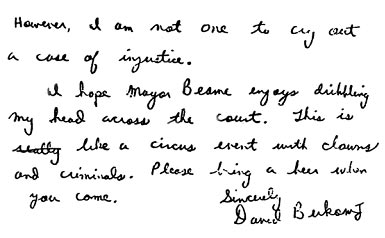
The 12 Handwriting characteristics is very important to forensic scientist students because it helps to examine forgery in checks and other forgery of notes in a crime. Everybody has a unique personality in their handwriting because of spontaneous interactions between someone’s brain, eyes and hands. Handwriting can change by that physical or emotion state that person might be going through. As a person gets older, their handwriting gets distinctions. These  are the 12 different handwriting analysis characteristics. The first handwriting characteristic is line quality, which means that the handwriting could have been shaky or might have free smooth flow of words. The second handwriting characteristic is called the spacing of words and letters. This handwriting characteristic means that letters in the handwriting might have consistent spaces or no spaces between the letters of the words. The third handwriting characteristic is called the examination of ratio of height, width, and size of letters.


    This handwriting characteristic means that the letters in a word could start with tall large letters then end with short thick letters. It matters how the letter of the words balance out. The fourth examination technique is pen lifting which means the writer may start writing a word from a note then stop in the middle of the word and then start all over again. The pen lifting technique is very important to examine because it can usually mean forgery is taking place. The fifth examination is the connecting strokes this means that the capital letters may be connected to the lower case letters. The sixth examination is called the beginning and ending strokes, which means the letters may have curls, loops and may have a upward or downward stroke. The seventh examination is called Unusual letter formation this means letters could form letters with backward letters and unusual attributes on letters of words. I often myself do that in a lot of my handwritten notes. I have tried to stop that particular technique but it always tends become a habit after while. I guess my mind starts always cursive letters and then starts with normal print handwriting. I guess in my fifth and sixth grade year my mind gets mixed up on cursive lettering and that is why I have weird letter formations. The eighth examination is called pen pressure means that if the note might have upward and downward strokes all through the words. When tracing is taking place in a forgery of a note or check pen pressure is sometimes applied during tracing. The ninth handwriting characteristic is slant letters which means there could be letters that are slant from the right or the left side. The tenth handwriting characteristic is baseline habits. This means that letters in the word could be below the particular imaginary line or all on the same line. The eleventh handwriting characteristic is fancy writing habits. This handwriting characteristic means that the letters in the word could have extra trimmings or frills. The last handwriting analysis characteristic is diacritics. Diacritic means that writing is examined how the t’s are crossed and how the I’s are dotted. They could be to the left or the right of the letter. They also could have not crossed the t's and dotted the I’s.


"Handwriting Analysis Teacher Background Information." Forensic Investigations. Web. 4 Nov. 2011. <http://www.clt.uwa.edu.au/__data/page/112506/fsp10_handwriting.pdf>.

This website gets  the credibility for idea about each handwriting analysis characteristic and their specific meaning.

Citations for pictures
Koren, Anna. "Handwriting Analysis - Cold Case Investigations." Cold Case Investigations - Powered by VBulletin. Web. 04 Dec. 2011. <http://officialcoldcaseinvestigations.com/showthread.php?t=509>.



Wednesday, November 23, 2011

Forensic Science Project Part III: Hand Wrting Analysis

History of Handwriting Analysis

                                                                                                                                                                                                                                                                                                                                         
  • Aristotle
    Alfred Binet
    Everyone has a unique way of writing. Forensic scientist students need to know that the history behind handwriting analysis so they can easily enhance their understanding of handwriting characteristics. Handwriting is a boring and precise process that relies on knowledge of the way people form letters. Therefore, there are some important people who studied the difference between handwriting. Here below is a brief history of people who studied handwriting analysis. A Greek philosopher Aristotle, nearly over 2,000 years ago, discovered a correlation with the Chinese that they were a connection between someone’s character and their writing techniques. An unknown Italian professor of philosophy created a book in 1622 that gave a description about the analysis of character when he was studying handwriting. Abbe Michon was a principal of a school in Paris. He created a book on the subject of graphology. Graphology is the study of written and printed symbols that to tell a person’s character. Dr. Ludwig Klages, a graphologist, applied the gestalt theory to get a better understanding of the theories about rhythm and form level. The gestalt theory means how people organize visuals and unify visuals to understand an important principle. For example I have a birds head and it is compared a sun together the visuals unify a mean a important principle. Dr .Ludwig Klages applied this theory to advance his theories in rhythm and “form level”. Handwriting can correlate between someone’s personalities.  Pierre Janet, a French psychologist, referred handwriting to the “science of the future”. Pierre Janet also made a film record about a writer’s sensibilities. He also described handwriting as an act which leaves a printout.  Alfred Binet was a psychologist who created I.Q testing for intelligence and observed that handwriting can tell character traits.I did not know there were abundant of people who have studied handwriting analysis. I always thought that handwriting was not a big deal. After all we use handwriting pretty much every single minute of the day. It was not until now I realized handwriting add unique characteristics and can tell you about that person’s personality. That is amazing to see. Sometimes I do wonder what my personality is that is connected to my handwriting. My handwriting is very neat but is a mixture of cursive and print letters. I guess personality is very different than a lot of peoples.  
    Citations
"A Brief History and Background of Handwriting Analysis or Graphology." Handwriting Analysis. Learn to Analyze Handwriting at Graphic Insight. Web. 03 Dec 2011.  <http://graphicinsight.co.za/background.htm>.
This website gets the credibility of all the research containing the history of handwriting analysis. 
Citations for pictures
"Aristotle." Wikipedia, the Free Encyclopedia. Web. 03 Dec. 2011. <http://en.wikipedia.org/wiki/Aristotle>.
This website gets the credibility for the visual image of Aristotle.

"Facts About Feeling Hog-tied If You Just THINK You Have a High or Low IQ." Share Knowledge & Earn Passive Income | Factoidz. Web. 03 Dec. 2011. <http://factoidz.com/facts-about-feeling-hogtied-if-you-just-think-you-have-a-high-or-low-iq/>.
This website gets the credibility for the visual image of Alfred Binet.


Links

      Tuesday, November 22, 2011

      Forensic Science Project Part II- Hair/FIber Analysis

      History of Hair and Fibers


      History of Hair/Fiber Analysis


      The history of hair/fiber analysis is very important to forensic scientist students to reveal different hairs and fibers such as dog hair or human hair. The brief studies of hair/fiber analysis below show the different people who participated in studies of hair and fibers. Starting in the 1800s, crime scène investigators noticed that hair was an important part of trace evidence at a crime scene. Crime scene investigators found hair that was trace evidence in the murder case of Duschesse de Praeslin in Paris in the year of 1874. Forensic scientist students need to know that hair is the most common type of hair evidence. I think this is important that trace evidence including hair is found because it identifies  an unknown victim or suspect during the crime. When hair used in conjunction with D.N.A. and other evidence, it can be a powerful tool for an investigator. My personal opinion of this is that hair can tell hidden details and define any person during the scene of a crime . Therefore, hair is one of the strong tools for investigations.   


      In the year of 1883, a man named Alfred Swaine Taylor wrote a book called The Principle and Practice of Medical Jurisprudence .In his book , he included drawings of the labeled parts of human hair.  The book is also about the use of hair in forensic investigations. Without Alfred Swaine Taylor drawings, no one would know the specific parts of the human hair. I think that knowing the different parts of the human hair including papilla, which is at the base of the hair follicle and made up of connective tissue will show to forensic scientist students that the basic structure of hair drawings is very important. Also without Alfred Taylor writings about the use of human hair in investigations, forensic scientist students would not know that D.N.A of a hair sample can show the race of that particular person and gender. Alfred Taylors writings of the use of hair in investigations collecting hair samples in investigations proves an abundant of things in crime scenes including who the victim and a suspect of the crime are. Therefore, Alfred Taylor’s writings of the use of hair and drawings of human hair in crime scene investigations were a big contributor to the history of hair analysis.


      In 1910, French forensic scientists Victore Balthazard and Marcelle Lambert did a study of hair titled The Hair of Man and Animals. The book includes numerous amounts studies of hair from most animals. This particular study reveals that there is an abundant amount of differences between human hair and animal hair. Animal hairs are incomparable to human hairs in some ways such as human hair even color pigmentation throughout the hair strand. Animal hairs have color variations, which is also known as banding. I think there has always been a difference between human hair and animal hair. The two are very different objects between humans and animals.


      Fiber Analysis


      In crime scene investigations police try to find fibers to a link a suspect to a crime. These are some descriptions of people who has discovered or study about fibers. Edmond Locard  was forensic scientist who created this important principle that said “Every contact leaves a trace”. Criminals always leave some trace of evidence on car seats, trunks or anywhere near the crime scene. Edmond Locard realized that this material was a key ingredient to analyzing a crime. He created the “Locard Exchange Principle” which became the foundation of forensic science. Rudolph Virchow who was a German pathologist revealed that hairs were not unique enough to match a suspect to a victim. A man named Paul L. Kirk wrote a book about “Criminal Investigation” in this book he wrote about the fundamentals of microscopic hair analysis used by the scientist in that time period.


      These are the contributors studied about hairs and fibers. Hairs and fibers are important today because they can help solve a crime. So without these contributors we would today not know a lot about hairs and fibers. Without these people, I would just think hair is useless but now I know that hair is important thing in life. I already know hair on top of my head is important to me. I mean the analyzing of hair just not knowing how to straighten hair.


      Citations


      Contursi, Janet. "Forensic Analysis of Hair | EHow.com." EHow | How to Videos, Articles & More - Discover the Expert in You. | EHow.com. Web. 05 Dec. 2011. <http://www.ehow.com/about_5597295_forensic-analysis-hair.html>.


      Links